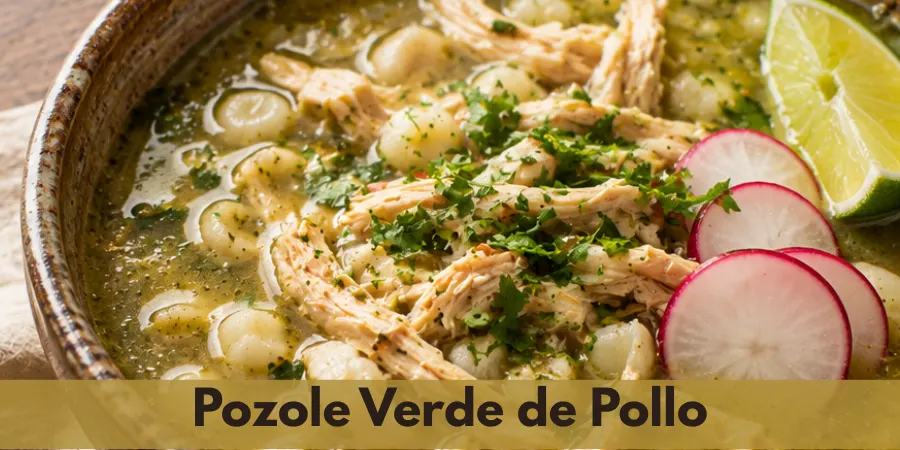
Pozole Verde, also called Pozole Verde de Pollo, is a traditional Mexican stew known for its bright tomatillo-based broth and satisfying flavor. This chicken pozole combines tender shredded chicken with white hominy, fresh tomatillos, poblano peppers, and jalapeños to create a flavorful green chile stew.
This comforting one-pot meal balances fresh ingredients with a rich savory broth, making it perfect for family dinners, gatherings, or a cozy homemade meal.
Pozole Verde de Pollo-The Short Answer
One reason this version stands out is how a Dutch oven makes traditional-style pozole practical for home cooking. Sautéing the vegetables first develops the aromatic base, while blending the softened vegetables with cilantro creates a smooth green chile broth.
Briefly cooking the blended salsa adds extra depth before combining it with the remaining broth.
For an optional restaurant-style version, toasted pumpkin seeds can be blended into the salsa. They add nutty richness and natural body while keeping the recipe dairy-free and flour-free.
Why You’ll Love This Recipe
If you are looking for a comforting Mexican chicken stew, Pozole Verde is a recipe worth trying. This one-pot recipe combines fresh ingredients with everyday pantry staples to create a flavorful meal that feels complete in every bowl.
Chicken thighs help keep the meat juicy during the gentle simmer, while fresh tomatillos provide the signature tangy green chile flavor. Poblano peppers and jalapeños add depth while allowing the heat level to remain balanced.
Another advantage of this recipe is how easily you can adjust the spice level. Keep the standard medium version with two jalapeños, use Anaheim peppers for a milder variation, or add serrano peppers for a hotter finish.
Ingredients
The best Pozole Verde starts with a balanced combination of fresh vegetables, tender chicken, hominy and Mexican herbs.
Chicken
- 2½ pounds boneless skinless chicken thighs (approximately 1.13 kilograms)
Chicken thighs are the standard protein for this recipe because they stay juicy during the gentle simmer and provide a richer broth than chicken breast.
Green Chile Base
- 1½ pounds fresh tomatillos (approximately 680 grams)
- 4 medium poblano peppers (approximately 450–500 grams)
- 2 medium jalapeños (approximately 30–40 grams)
- 1 large white onion (approximately 250 grams)
- 5 large garlic cloves (approximately 20 grams)
Fresh tomatillos provide the bright acidity and green color that define the broth. Poblanos contribute body and earthy green chile flavor, while jalapeños provide the standard medium level of heat.
Broth and Hominy
- 6 cups low-sodium chicken broth (approximately 1.42 liters)
- 2 (15-ounce) cans white hominy, drained and rinsed
Low-sodium broth gives you better control over the final seasoning. White hominy provides the traditional corn flavor and chewy texture expected in pozole.
Herbs and Seasonings
- ¾ cup loosely packed fresh cilantro (approximately 30 grams)
- 1 tablespoon Mexican oregano (approximately 5 grams)
- 2 dried bay leaves
- 2 teaspoons kosher salt (approximately 12 grams)
- ½ teaspoon freshly ground black pepper (approximately 1 gram)
Fresh cilantro is added during blending rather than simmered from the beginning to preserve its fresh herbal flavor and vibrant color. Mexican oregano provides the citrusy-earthy aroma associated with the dish.
Oil
- 1 tablespoon neutral cooking oil (approximately 15 ml)
Avocado oil, canola oil or another neutral cooking oil can be used.
Optional Restaurant-Style Upgrade
- ½ cup raw hulled pumpkin seeds (approximately 60 grams)
- 1 tablespoon chicken fat or neutral oil (approximately 15 ml) for searing the blended salsa
The pumpkin seeds are toasted and blended into the green salsa. They provide natural body and nutty richness without dairy or flour.
How to Prepare the Ingredients
Prepare the Chicken
Use 2½ pounds of boneless skinless chicken thighs. Pat away excess surface moisture and trim any large pieces of loose fat.
Keep the chicken thighs whole rather than cutting them into cubes. Whole thighs retain moisture well during simmering and are easier to shred after cooking.
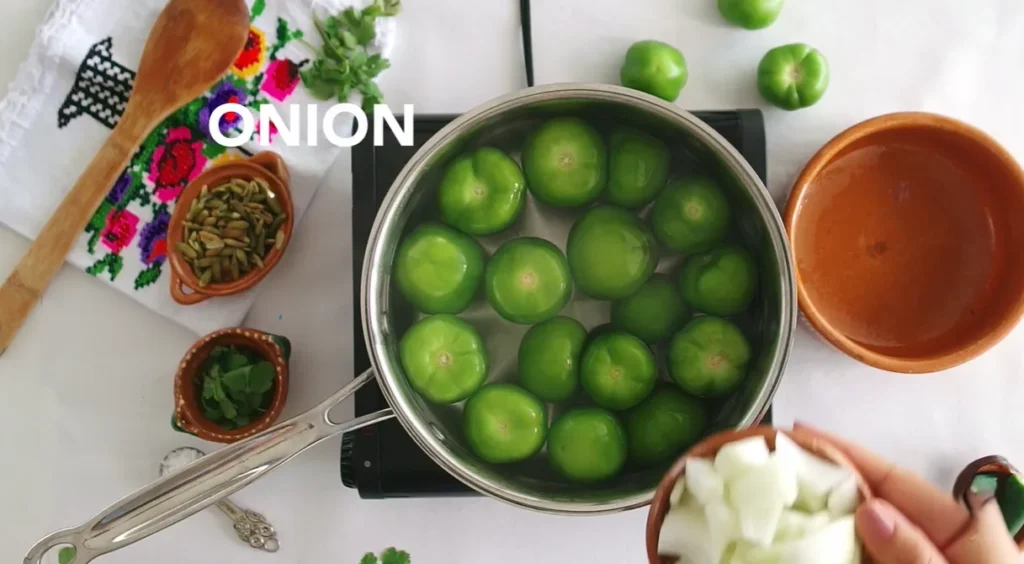
Prepare the Tomatillos
Remove the papery husks from the tomatillos and rinse away the sticky coating under cold running water. Dry them thoroughly.
Cut large tomatillos into halves or quarters. Small tomatillos can remain whole.
Prepare the Poblano Peppers
Wash and dry the four poblano peppers. Remove the stems, seeds and thick white membranes, then cut the peppers into large pieces.
Prepare the Jalapeños
Wash the two jalapeños and remove the stems. Remove the seeds for the standard medium version. Keep the seeds and membranes for a hotter variation.
Prepare the Anaheim Pepper
For the optional mild variation, use 1 Anaheim pepper. Remove the stem and seeds and cut it into large pieces.
Prepare the Onion
Peel the white onion and cut it into approximately 2–3 cm pieces.
Prepare the Garlic
Peel the five garlic cloves. Large cloves can be halved.
The garlic does not need to be minced because it will later be blended with the cooked vegetables.
Prepare the Cilantro
Wash approximately 30 grams of fresh cilantro and dry it thoroughly. Use the leaves and tender stems while removing thick woody stems.
Reserve the cilantro for the blending stage.
Prepare the Hominy
Drain the two cans of white hominy in a colander and rinse under cold running water for 30–60 seconds. Allow the excess liquid to drain completely.
Keep the hominy refrigerated or set aside until the final simmering stage.
Prepare the Pumpkin Seeds
For the optional restaurant-style version, toast 60 grams of raw hulled pumpkin seeds in a dry skillet over medium heat for 3–5 minutes.
Stir continuously until they develop light golden spots and a nutty aroma. Remove them from the heat and allow them to cool before blending.
Cooking Method
1. Sauté the Onion
Place a 7–8 quart Dutch oven over medium heat and allow it to preheat for about 2–3 minutes.
Add 1 tablespoon of neutral cooking oil.
Add the prepared onion and cook for about 5–6 minutes, stirring every 45–60 seconds. The onion should soften and become translucent with only light golden edges.
Do not deeply brown or caramelize the onion.
2. Add the Garlic
Add the prepared garlic cloves and cook for 60–90 seconds, stirring continuously.
The garlic should become fragrant and lightly softened. Avoid browning it deeply because burnt garlic can make the broth bitter.
3. Add the Peppers
Add the poblano peppers, jalapeños and optional Anaheim pepper.
Cook for about 6–8 minutes over medium heat, stirring about once each minute.
The peppers should soften and begin releasing moisture. Complete charring is not necessary for the standard version.
4. Add the Tomatillos
Add the prepared tomatillos and cook for about 2–3 minutes.
They should become glossy, soften slightly and begin releasing their natural juices.
5. Add the Herbs
Add the Mexican oregano and bay leaves. Cook with the vegetables for about 60 seconds to release their aroma.
6. Add the Chicken
Place the whole chicken thighs over the vegetables.
They do not need to be completely submerged yet.
Allow the chicken to cook with the vegetables for about 2 minutes before adding the broth.
7. Add the Broth
Slowly pour in 6 cups of low-sodium chicken broth.
The broth should almost cover the chicken and vegetables. Do not automatically add additional broth because the locked liquid ratio is designed to produce a concentrated but balanced broth.
8. Bring to a Gentle Boil
Increase the heat to medium-high and bring the broth to a gentle boil.
This should take about 8–10 minutes.
Once small steady bubbles appear, reduce the heat immediately. Avoid maintaining a large rolling boil.
9. Simmer the Chicken
Reduce the heat to low and partially cover the Dutch oven, leaving a small opening for steam to escape.
Simmer the chicken for approximately 40–45 minutes.
The broth should maintain a gentle simmer rather than a vigorous boil.
The chicken is ready when it reaches 74°C (165°F) and can be separated easily with a fork.
The tomatillos should be completely softened and the peppers should be tender.
Blend the Green Salsa
1. Remove the Chicken
Use kitchen tongs to transfer the cooked chicken to a cutting board.
Let it rest for approximately 8–10 minutes before shredding.
2. Remove the Bay Leaves
Remove both bay leaves from the cooking liquid and discard them.
Do not blend bay leaves with the vegetables.
3. Transfer the Vegetables
Use a large slotted spoon to transfer the cooked tomatillos, poblanos, jalapeños, optional Anaheim pepper, onion and garlic to a large blender.
Keep the remaining broth in the Dutch oven.
4. Add the Measured Broth
Add 1½ cups (approximately 360 ml) of the hot cooking broth to the blender.
Do not transfer the entire pot of broth to the blender.
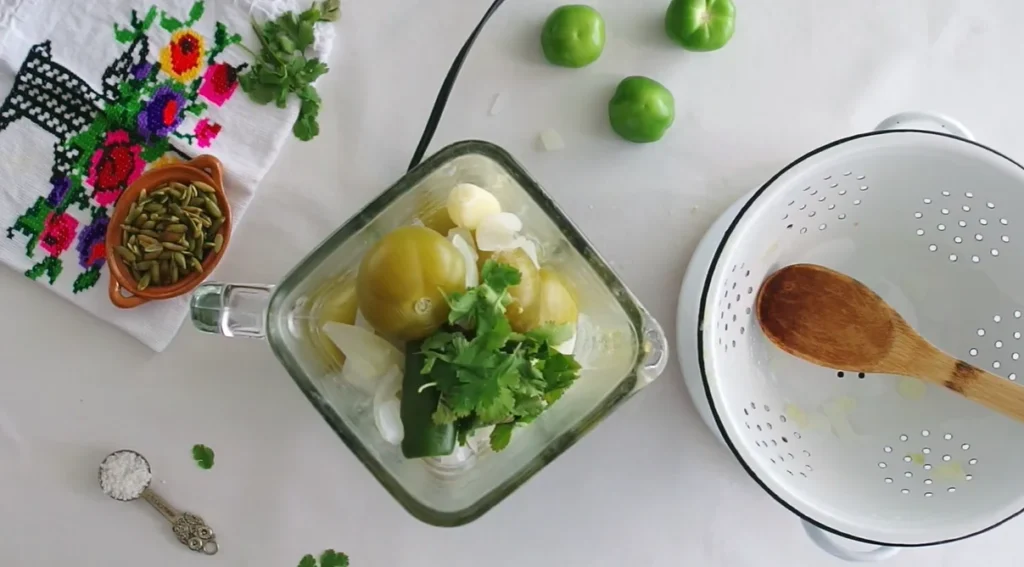
5. Add the Cilantro
Add approximately 30 grams of fresh cilantro, including the tender stems.
6. Add the Pumpkin Seeds
For the optional restaurant-style version, add the 60 grams of toasted pumpkin seeds.
Skip this step for the standard home version.
7. Blend
Secure the blender lid and allow steam to escape according to the blender manufacturer’s instructions.
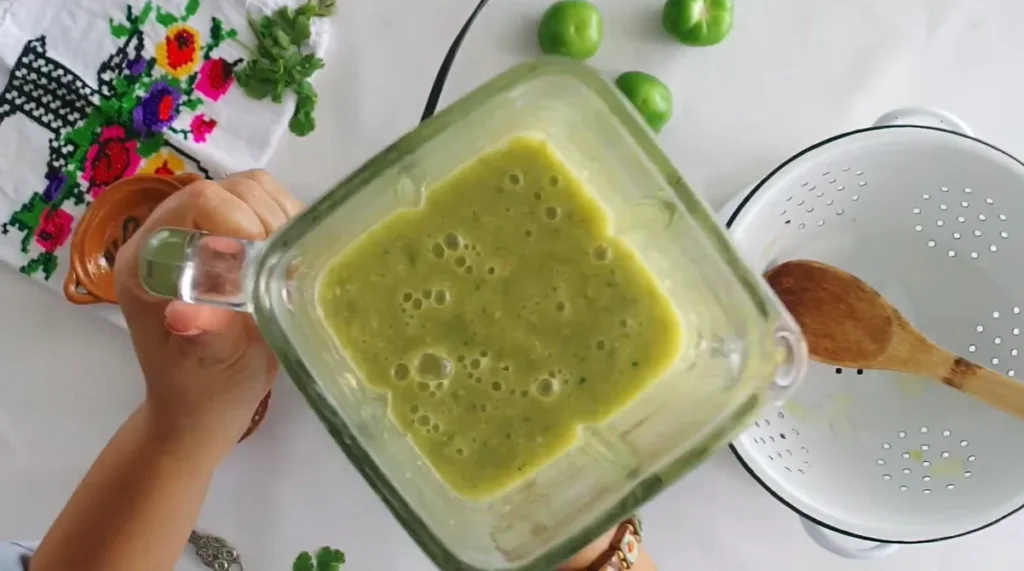
Blend on high for approximately 90–120 seconds.
The finished salsa should be completely smooth, silky and pourable with no large vegetable pieces remaining.
Sear the Green Salsa
Return the Dutch oven to medium heat.
For the restaurant-style version, add 1 tablespoon of chicken fat or neutral oil.
Carefully pour in the blended green salsa and cook for approximately 3–5 minutes, stirring continuously.
The salsa should become slightly darker, more aromatic and slightly thicker.
The raw tomatillo flavor should mellow without allowing the salsa to burn.
Pour the remaining broth back into the pot and stir until the salsa and broth are fully combined.
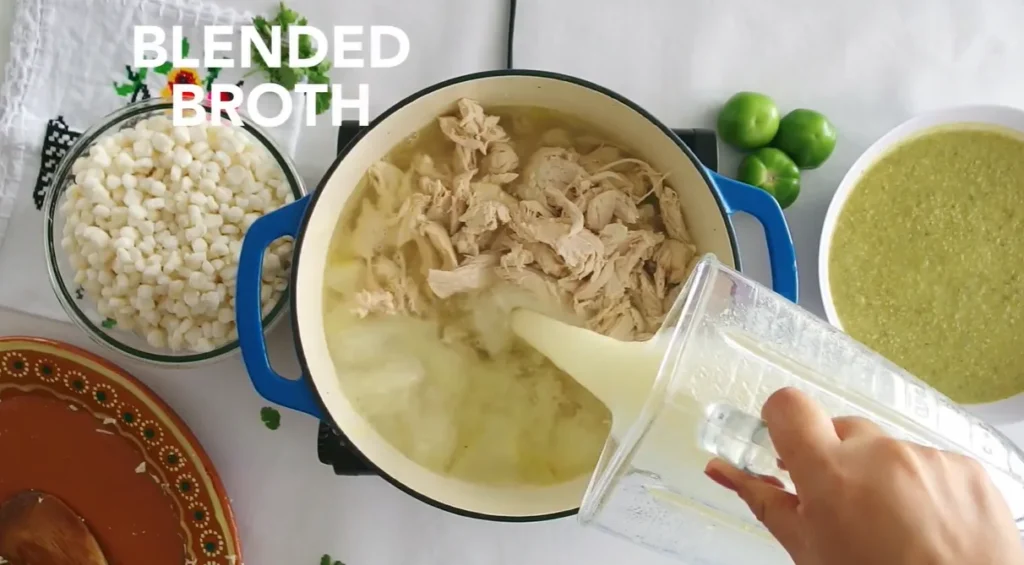
Shred the Chicken
Allow the cooked chicken to rest for approximately 8–10 minutes, then shred it using two forks or clean hands.
Aim for medium pieces approximately 3–5 cm long.
Avoid shredding the chicken too finely because medium pieces provide a better texture in the finished pozole.
Add the Chicken and Hominy
Return the shredded chicken to the Dutch oven.
Add the drained and rinsed white hominy.
Stir gently for about 30–60 seconds so the ingredients are evenly distributed.
Final Simmer
Reduce the heat to medium-low.
Simmer the Pozole Verde uncovered for approximately 12–15 minutes.
The broth should maintain gentle bubbles rather than a rolling boil.
This final simmer allows the chicken to absorb the green broth while the hominy heats through and maintains its chewy texture.
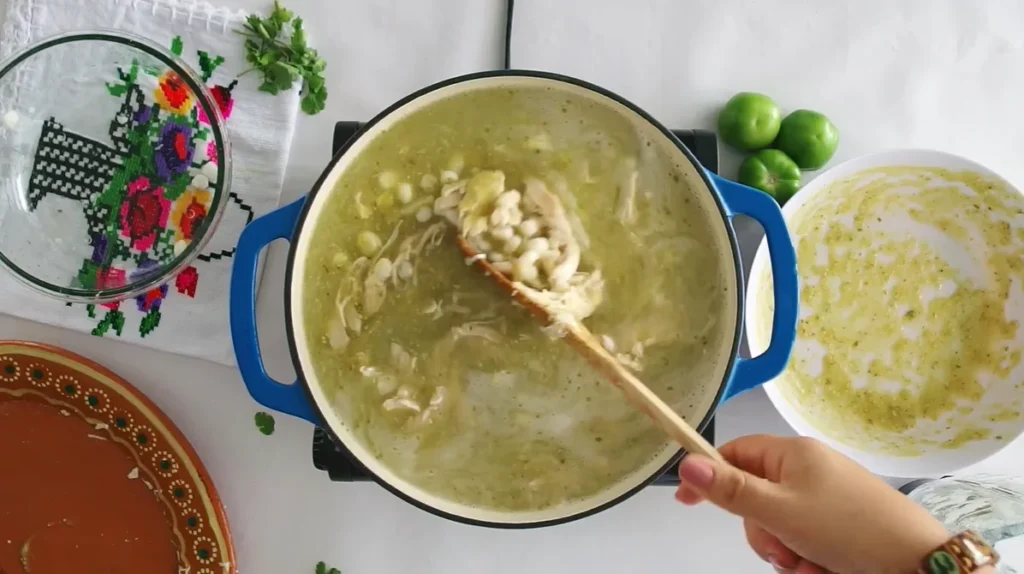
Taste and Adjust the Seasoning
After the final simmer, taste the broth.
If additional salt is needed, add approximately ¼ teaspoon at a time, stirring and tasting between additions.
The final broth should be:
- Tangy
- Savory
- Herbal
- Moderately spicy
- Smooth
- Medium-bodied
No single flavor should dominate.
Adjust the Consistency
If the broth becomes too thick, add reserved hot chicken broth ¼ cup (60 ml) at a time.
Up to 1 cup (240 ml) can be used for adjustment if necessary.
If the broth is too thin, simmer it uncovered for an additional 5–8 minutes to allow natural reduction.
Do not use flour or cornstarch to thicken the broth.
Recipe Variations
Mild Pozole Verde
Use:
- 4 poblano peppers
- 1 Anaheim pepper
- Jalapeños omitted
This keeps the green chile character while noticeably reducing the heat.
Hot Pozole Verde
For more heat, replace the optional Anaheim pepper with 1 serrano pepper.
For an extra-hot version, use 2 serrano peppers along with the standard poblano and jalapeño combination.
Chicken Breast
Use 2½ pounds boneless skinless chicken breast if you prefer a leaner protein.
Chicken breast produces a lighter broth and should be monitored carefully to prevent overcooking.
Bone-In Chicken
Use 3 pounds of chicken leg quarters for a richer broth with additional collagen and deeper savory flavor.
Bone-in chicken requires a longer cooking time of approximately 50–60 minutes.
Remove the bones after the chicken has cooled enough to handle.
Mixed Chicken
Use:
- 1¼ pounds chicken thighs
- 1¼ pounds chicken breast
This provides a balance between richness and leaner meat.
Vegetarian Pozole Verde
Replace the chicken with:
- 2 cups zucchini (approximately 280 grams)
- 2 cups mushrooms (approximately 140 grams)
- 2 medium potatoes (approximately 300 grams)
Use 6 cups vegetable broth instead of chicken broth.
An optional 15-ounce can of drained white beans can be added for extra protein.
White or Yellow Hominy
White hominy is the standard choice and provides a clean appearance and traditional flavor.
Yellow hominy can also be used and will provide a slightly sweeter corn flavor.
Dried Hominy
Dried hominy is an advanced variation. Use approximately 450 grams dried hominy and soak it overnight before cooking until completely tender.
Fresh or Canned Tomatillos
Fresh tomatillos are preferred for their bright acidity and clean flavor.
If canned tomatillos are used, choose approximately 1½ pounds drained tomatillos. Their preparation differs from fresh tomatillos, so they can be added directly to the blender rather than simmered in the pot.
Herb Variation
Mexican oregano and cilantro are the standard herbs.
For an optional regional variation, add 2 small sprigs of epazote during cooking and remove the stems before serving.
If cilantro is not preferred, flat-leaf parsley can be used, although the flavor will be noticeably different.
Broth Variation
Homemade chicken stock can provide additional richness and natural gelatin.
Low-sodium store-bought chicken broth is the practical everyday option because it gives you better control over seasoning.
For the vegetarian version, use low-sodium vegetable broth.
Tips for the Best Pozole Verde
Use Chicken Thighs
Boneless skinless chicken thighs are the standard choice because they remain juicy and provide a richer broth than chicken breast.
Bone-in chicken can also be used when you want additional collagen and deeper savory flavor.
Choose Fresh Tomatillos
Look for firm, bright green tomatillos with fresh papery husks.
Remove the husks and wash away the sticky coating before cooking.
If fresh tomatillos are unavailable, canned tomatillos can be used as an alternative.
Control the Heat
The standard combination of four poblanos and two jalapeños provides a medium level of heat.
For a milder version, remove the jalapeño seeds or replace the jalapeños with Anaheim peppers.
For more heat, add serrano peppers.
Use Mexican Oregano
Mexican oregano provides the citrusy-earthy notes that complement the tomatillos and green chiles.
Regular oregano can be used if Mexican oregano is unavailable, although the flavor will be slightly different.
Blend the Vegetables Smoothly
The cooked vegetables should be completely blended before returning to the broth.
A high-speed blender provides the smoothest result, although a standard blender can also work.
Add Hominy Near the End
Adding the hominy during the final 12–15 minute simmer helps preserve its tender but chewy texture.
Adding it at the beginning can make the kernels softer than intended.
Troubleshooting
Broth Is Too Thin
Possible causes:
- Too much broth was used.
- The vegetables did not reduce enough.
- The salsa was not seared sufficiently.
- The final simmer was too short.
Solution:
Simmer the pozole uncovered for another 5–10 minutes over medium-low heat. Do not add more broth.
Broth Is Too Thick
Possible causes:
- Excessive reduction.
- A longer-than-needed simmer.
- Too many pumpkin seeds in the optional version.
Solution:
Add reserved hot chicken broth ¼ cup (60 ml) at a time and check the consistency after each addition.
Broth Is Too Sour
Possible causes:
- The tomatillos were unusually tart.
- The onion quantity was reduced.
- The tomatillos were not cooked sufficiently.
Solution:
Continue simmering for another 5–10 minutes.
If the acidity remains unusually sharp, add ½ teaspoon honey or ½ teaspoon sugar as a last resort.
Broth Is Too Bland
Possible causes:
- Insufficient salt.
- Salsa was not properly seared.
- Broth lacked flavor.
Solution:
Add ¼ teaspoon kosher salt at a time and taste after each addition.
If needed, crush an additional ½ teaspoon Mexican oregano between your palms and add it to the broth, then simmer for 3–5 minutes.
Broth Tastes Bitter
Possible causes:
- Burnt garlic.
- Excessively charred peppers.
- Burnt salsa.
Burnt flavors cannot always be completely corrected. If possible, dilute the broth with ½–1 cup additional broth and rebalance the seasoning.
Chicken Is Dry
Possible causes:
- Overcooking.
- Vigorous boiling.
- Overcooked chicken breast.
Solution:
Use boneless chicken thighs for the standard version and remove the chicken when it reaches 74°C (165°F).
Chicken Is Difficult to Shred
Possible cause:
The chicken may not be fully tender.
Solution:
Return it to a gentle simmer for another 5–10 minutes, then allow it to rest before shredding again.
Hominy Is Mushy
Possible causes:
- Hominy was added too early.
- Excessive simmering.
- Aggressive stirring.
Solution:
Add hominy only during the final 12–15 minute simmer and stir gently.
Hominy Is Too Firm
Possible cause:
The final simmer was too short.
Solution:
Continue simmering for another 5 minutes and check again.
Salsa Is Grainy
Possible causes:
- Blender power was insufficient.
- Blending time was too short.
- Pumpkin seeds were not fully incorporated.
Solution:
Blend for another 30–60 seconds. A fine mesh strainer can be used if a smoother broth is desired.
Green Color Is Dull
Possible causes:
- Overcooking.
- Excessive salsa searing.
- Cilantro was cooked too long.
Solution:
Add cilantro only during blending and avoid extending the final simmer unnecessarily.
Soup Is Too Spicy
Possible causes:
- Jalapeño seeds were retained.
- Serrano peppers were used.
Solution:
Add additional hot broth or hominy to moderate the heat. Avocado can also provide a cooling contrast when served as a topping.
Soup Is Not Spicy Enough
Add freshly sliced jalapeños as a garnish or serve chile flakes on the side.
Make-Ahead Instructions
Prepare Ingredients Ahead
Tomatillos can be husked and washed up to 2 days ahead. Dry them completely before refrigerating in an airtight container.
Poblano, Anaheim and jalapeño peppers can be chopped up to 2 days ahead.
Onion and garlic can be prepared up to 24 hours ahead.
Cilantro can be washed, dried thoroughly and refrigerated with a paper towel in an airtight container.
Cabbage and radishes can be sliced 1 day ahead.
Cut lime wedges on the day of serving. Prepare avocado immediately before serving.
Prepare the Green Salsa Ahead
The cooked tomatillos, peppers, onion and garlic can be blended ahead of time.
Cool the salsa completely, then refrigerate it in an airtight container for up to 3 days.
Stir gently before using.
Prepare the Chicken Ahead
The chicken can be cooked and shredded ahead of time.
Cool it completely and refrigerate it with a small amount of broth in an airtight container for up to 3 days.
Keeping some broth with the chicken helps prevent it from drying out.
Complete Pozole Make-Ahead
The entire Pozole Verde can be prepared one day ahead.
Overnight refrigeration allows the flavors to develop further. Reheat gently the following day and add fresh garnishes after reheating.
For meal preparation, store the broth, chicken, hominy and fresh garnishes separately when possible. Combine them when serving to preserve the best garnish texture.
Storage Instructions
Refrigerator
Do not leave the cooked pozole at room temperature for more than 2 hours.
Once cooled, transfer it to an airtight container and refrigerate at 4°C (40°F) or below.
Best quality is maintained for up to 4 days.
Freezer
Cool the pozole completely before transferring it to freezer-safe containers.
Leave approximately 2 cm of space at the top for expansion.
Label the container with the preparation date.
Pozole can be frozen for up to 3 months.
Fresh garnishes should not be frozen.
Thawing
The preferred method is to thaw frozen pozole in the refrigerator overnight for approximately 8–12 hours.
For a faster method, place the sealed container in cold water and replace the water every 30 minutes.
Do not thaw the pozole at room temperature.
Reheating Instructions
Stovetop
Transfer the pozole to a Dutch oven or saucepan.
Heat over medium-low heat for approximately 8–12 minutes, stirring occasionally.
Avoid a rolling boil.
If the broth has thickened during storage, add approximately ¼–½ cup (60–120 ml) additional chicken broth.
Microwave
Transfer the pozole to a microwave-safe bowl and loosely cover it.
Heat for 2–3 minutes, stir, then continue with 30-second intervals until heated through.
Thawed pozole is preferred for reheating. Direct reheating from frozen is not recommended.
How to Serve
Serve the pozole hot with evenly distributed chicken, hominy and green broth.
Traditional toppings include:
- Shredded cabbage
- Diced white onion
- Sliced radishes
- Chopped cilantro
- Mexican oregano
- Lime wedges
For a more elaborate presentation, add avocado, toasted pumpkin seeds, sliced jalapeños, tortilla strips or queso fresco.
Warm corn tortillas, tostadas or tortilla chips can be served alongside the soup.
Serving Ideas
Holiday Meal
Arrange the garnishes buffet-style so everyone can customize their bowl.
Meal Prep
Store the broth and fresh garnishes separately and combine them when serving.
Nutrition
Based on the locked recipe formula and 8 servings, each serving contains approximately:
- Calories: 365 kcal
- Carbohydrates: 24 g
- Protein: 34 g
- Total Fat: 15 g
- Saturated Fat: 4 g
- Polyunsaturated Fat: 3 g
- Monounsaturated Fat: 6 g
- Trans Fat: 0 g
- Cholesterol: 135 mg
- Sodium: 865 mg
- Potassium: 810 mg
- Fiber: 6 g
- Sugar: 6 g
- Vitamin A: 1,150 IU
- Vitamin C: 48 mg
- Calcium: 78 mg
- Iron: 3 mg
Nutrition information is an estimate based on the locked recipe formula and may vary slightly depending on the brands of broth, hominy and other ingredients used.
Frequently Asked Questions
Does chicken pozole keep well?
Yes. Pozole Verde can be refrigerated in an airtight container for up to 4 days or frozen for up to 3 months.
The flavors can become more developed after refrigeration. Reheat gently on the stovetop or in the microwave and add fresh garnishes after reheating.
What does chicken pozole verde taste like?
Pozole Verde has a bright, tangy flavor from fresh tomatillos with savory richness from chicken thighs. Poblanos provide earthy green chile flavor while jalapeños add medium heat.
Fresh cilantro and Mexican oregano add herbal depth, while hominy contributes a tender, chewy corn texture.
The finished broth should taste fresh and savory without becoming overly heavy.
Can I make Pozole Verde less spicy?
Yes. Remove the jalapeño seeds for less heat or replace the jalapeños with Anaheim peppers.
For the mildest version, use four poblanos and one Anaheim pepper while omitting the jalapeños.
Can I make Pozole Verde with chicken breast?
Yes. Use 2½ pounds of boneless skinless chicken breast for a leaner variation.
Chicken breast produces a lighter broth, so monitor the cooking time carefully and avoid overcooking.
Can I use canned tomatillos?
Yes. Fresh tomatillos are preferred, but approximately 1½ pounds of drained canned tomatillos can be used.
For the canned version, add the tomatillos directly to the blender rather than simmering them with the chicken and vegetables.
Can I use yellow hominy?
Yes. White hominy is the standard choice, but yellow hominy can be substituted. It has a slightly sweeter corn flavor and a somewhat darker appearance.