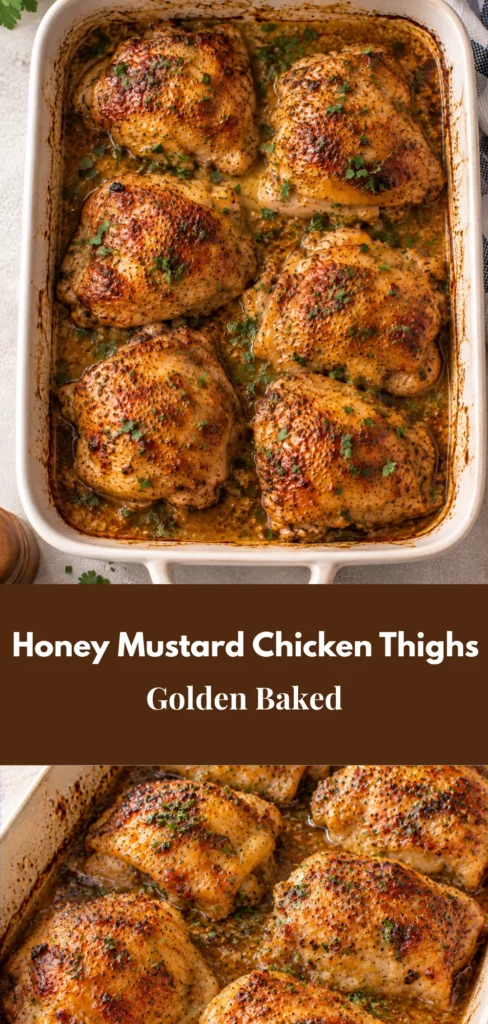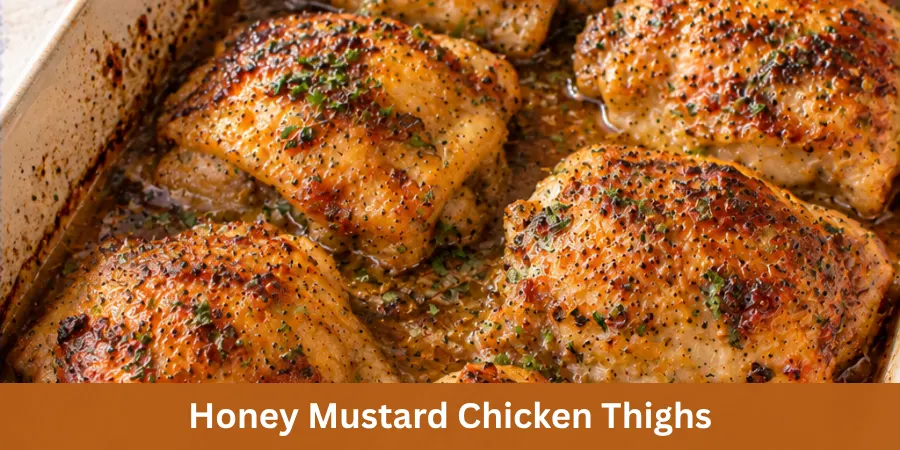
Starting with the honey mustard chicken idea, these honey mustard chicken thighs combine tender chicken thighs with a sweet-and-savory sauce for an easy one-skillet dish.
The bone-in chicken thighs stay succulent as they cook, while the honey mustard sauce adds a rich balance of sweetness and tang. The chicken is first seared and then finished with baking, making this a flavorful recipe without a complicated process.
Honey Mustard Chicken Thighs-The Short Answer
The baked chicken develops an irresistibly caramelized surface on the outside while staying tender inside. The chicken is seared before it goes into the oven, and the sauce is added in two stages to build a glossy, saucy coating.
This simple method creates flavorful chicken with a balanced combination of mustard and honey. The result is succulent chicken with a rich sauce and a deeply caramelized finish.
Why This Recipe
When I want a flavorful dinner without spending too much time on prep, this recipe is a great choice.
The chicken thighs need minimal preparation before they are seasoned and seared, then finished in the oven. This method helps create juicy chicken with a golden caramelized surface and a rich, tangy honey mustard flavor.
The honey mustard sauce adds a sweet and tangy coating as the chicken thighs bake, while the two-stage glazing helps build deeper flavor.
I also like how versatile this meal is because you can pair the chicken with favorite sides for a delicious meal without making dinner complicated.
Any leftovers can be reheated and used for lunch, making it a practical no-fuss meal for busy days.
About Honey Mustard
I started making honey mustard chicken thighs after my daughter came home from gymnastics class asking for restaurant food. Since I prefer cooking at home, I wanted to make home-cooked food that would still feel special for children.
The classic baked recipe combines the natural sweetness of honey with the tangy flavor of Dijon mustard. Garlic, rosemary, thyme, and smoked paprika add a savory layer without overpowering the sauce.
For the best texture, I use a hot oven after searing the bone-in chicken thighs. This helps the skin become golden, crisp, and caramelized while the juicy meat cooks through.
The homemade sauce is applied in two stages so it can build flavor without becoming too heavy. Fresh rosemary and thyme also add a pleasant fragrance as the chicken cooks.
It makes an easy meal for a family-friendly weeknight dinner. I like serving the cooked sliced chicken with pan drippings over white rice and a veggie side.
Roasted vegetables also work well alongside it and balance the rich honey-mustard sauce.
Ingredients Needed
2¾ pounds (1.25 kg) bone-in, skin-on chicken thighs
9 grams kosher salt
1 teaspoon freshly ground black pepper
1 tablespoon olive oil (15 ml)
¼ cup honey (approximately 85 g)
¼ cup Dijon mustard (approximately 60 g)
1 tablespoon apple cider vinegar (15 ml)
3 garlic cloves (approximately 9 g)
1½ teaspoons fresh rosemary (approximately 2 g)
1½ teaspoons fresh thyme leaves (approximately 1.5 g)
1 teaspoon smoked paprika (approximately 2.3 g)
¼ teaspoon red pepper flakes (approximately 0.5 g)
Fresh parsley or chopped parsley for optional garnish
Ingredients Notes
For this honey mustard chicken thighs recipe, use 2¾ pounds (1.25 kg) of bone-in, skin-on chicken thighs. This amount is designed for 6 servings.
Keep the main skin layer intact and trim only loose skin and excessive visible fat. The skin helps the thighs develop a browned surface while the rendered fat adds richness during cooking.
Season the chicken with 9 grams kosher salt and 1 teaspoon freshly ground black pepper.
For searing, use 1 tablespoon olive oil (15 ml) because the chicken will release additional fat as it cooks.
For the honey mustard sauce, combine ¼ cup honey (approximately 85 g) with ¼ cup Dijon mustard (approximately 60 g).
This equal-volume ratio creates the main sweet and tangy balance of the sauce.
Add 1 tablespoon apple cider vinegar (15 ml) to brighten the sweetness and mustard flavor.
The sauce also includes 3 garlic cloves, fresh rosemary, fresh thyme leaves, smoked paprika, and red pepper flakes.
For the aromatics, mince or grate the garlic. A microplane can be used when you want the garlic finely prepared.
Fresh rosemary and fresh thyme add herbal depth without overpowering the honey-Dijon base.
Smoked paprika brings mild smokiness, while red pepper flakes provide controlled heat.
Mix all sauce ingredients until smooth, then divide the sauce into 2 approximately equal portions.
One portion is used for the first glaze, and the other portion is used for the second glaze during the final cooking stage.
Fresh parsley or chopped parsley can be used as an optional garnish after cooking.
It adds a fresh finish and a light contrast to the rich honey mustard sauce.
How to Make
Start with chicken thighs that are skin-on and bone-in.
Trim only the extra skin and visible excess fat with kitchen scissors while keeping the main skin layer intact. Pat the chicken pieces thoroughly dry with a paper towel and season both sides with 9 grams kosher salt and 1 teaspoon freshly ground black pepper.
For the sauce, add ¼ cup honey, ¼ cup Dijon mustard, 1½ teaspoons fresh rosemary, 1½ teaspoons fresh thyme leaves, 3 garlic cloves, 1 teaspoon smoked paprika, ¼ teaspoon red pepper flakes, and 1 tablespoon apple cider vinegar to a small mixing bowl.
Whisk until smooth, then divide the honey mustard sauce into two approximately equal portions.
Heat 1 tablespoon olive oil in a large oven-safe skillet over medium heat.
Once the skillet is properly hot, place the thighs skin-side down and sear for about 7 minutes without moving them.
The skin should become golden brown and crisp.
Flip the chicken and sear the other side for 2 more minutes.
The chicken will not be fully cooked at this stage because the oven will finish the cooking.
Remove the thighs to a clean plate and carefully remove any excess oil or rendered fat from the skillet.
Return the chicken skin-side up, then brush the first portion of sauce over the tops.
Place the skillet in an oven preheated to 375°F and bake for approximately 15 minutes.
Remove the skillet carefully and brush the remaining sauce over the chicken.
Increase the oven temperature to 425°F and allow the oven to reach the new temperature before returning the skillet.
Continue cooking for approximately 10–15 minutes.
Start checking the thickest part with a meat thermometer at the 10-minute mark.
The chicken must reach 165°F as the minimum safe internal temperature, while 175°F is the preferred target for tender dark meat.
Because thigh size can vary, use the internal temperature rather than a fixed clock time to determine when the chicken is cooked through.
When the chicken reaches the target temperature, remove it from the oven and let it rest for 5 minutes.
The skin should be golden-brown and caramelized, while the sauce should look glossy and lightly caramelized around the edges without becoming burnt.
Garnish with parsley if desired and serve with the pan sauce for extra flavor.
This method gives you tender, juicy chicken with a flavorful honey-mustard coating without relying on a fixed cooking time alone.
Make It Your Own
This recipe is flexible when you want to adjust the flavor.
You can adjust the seasoning to suit your preference, especially the heat, garlic, and smoked paprika.
The fresh herbs add a balanced herbal note without overpowering the honey-mustard sauce.
Keeping the measured teaspoons and tablespoons consistent helps maintain the intended flavor balance.
For an easier cooking process, you can prepare the sauce while the chicken is being seasoned and the skillet is heating.
The searing step is worth keeping because it helps the skin brown and crisp before the chicken goes into the oven.
Once seared, brush the sauce over the chicken and bake it through the two-stage cooking process.
Check the meat with an instant-read thermometer rather than relying only on time.
This method works especially well for bone-in, skin-on pieces, giving the skin time to brown while the dark meat becomes tender.
Air Fryer
If you prefer fast cooking, this recipe can be adapted to an air fryer for a convenient meal.
I love how quickly an air fryer can cook chicken thighs while keeping the process simple.
Preheat the air fryer to 380°F (193°C) before adding the chicken.
Cook the chicken for approximately 20–25 minutes, depending on the size of the thighs and your air fryer.
Since cooking times can vary between appliances, check the thickest part of the chicken with an instant-read thermometer rather than relying only on the clock.
Cook until the chicken reaches 175°F (79°C) for the preferred tenderness or at least 165°F (74°C) for the minimum safe internal temperature.
Once it reaches the target temperature, remove it and let it rest for 5 minutes before serving.
Storage
For meal prep, allow the baked chicken thighs to cool before you store them.
Transfer the leftovers to an airtight container and keep them in the refrigerator for 2–3 days.
They work well for easy lunches and can be served cold over salads or added to sandwiches and wraps.
For reheating, it is best to reheat meats using the same method they were cooked initially.
Since these are baked chicken thighs, reheat them in the oven at 350°F (177°C).
This helps warm the chicken gently while protecting the sauce from burning.
The engineered recipe does not recommend a specific freezing method, so freezing instructions are not included here.
Make-Ahead
For easier weeknight meals, I like doing some meal prepping on the weekends, especially when I know the coming week will be busy.
My general method is to prepare the honey mustard sauce ahead and store it in a covered container in the refrigerator.
The sauce can be made 1–2 days ahead, then whisked before use.
This makes cooking day easier without changing how the chicken is prepared.
There is no need to freeze the raw chicken thighs or plan for thawing.
Instead, prepare the bone-in skin-on chicken thighs on the day you plan to cook them.
After seasoning, sear the chicken in a hot skillet, apply the first layer of sauce, and bake at the initial temperature.
Add the remaining sauce before the final high-heat baking stage so it develops a glossy coating and deeper caramelization.
For food safety, never use honey mustard or a marinade that has touched raw chicken on cooked chicken.
Once a marinade has contacted raw meat, do not re-use it.
Some people boil a marinade before using it again, but keeping a separate portion of fresh sauce for the finished chicken is the safer approach.
Tips and Tricks
The size of chicken thighs can vary, so start by trimming only the loose skin and excess visible fat with kitchen shears.
Keeping the main skin layer intact helps the chicken stay juicy while the fat renders during cooking.
Pat the chicken skin thoroughly dry with paper towels, then season both sides with salt and pepper.
Dry skin also helps it brown and turn crisp when it meets a properly heated pan.
For the best sear, use a large oven-proof skillet, preferably a cast iron pan, and let it get properly hot before adding the olive oil and chicken.
Place the thighs skin-side down and leave them undisturbed for about 7 minutes, then sear the other side for about 2 minutes.
This gives the skin time to develop a deeper brown color and caramelized crust through the Maillard reaction.
A stainless steel splatter screen can help reduce splatter.
When transferring the chicken, keep the pieces from excessively overlapping in the skillet rather than trying to force them into one layer.
A baking dish can also be used if needed before brushing on the sauce and baking.
Ovens can vary, so cooking time should be treated as a guide rather than the final measure of doneness.
After the first bake at 375°F, apply the second layer of sauce and finish at 425°F.
Start checking the chicken temperature at the 10-minute mark during the final stage.
For bone-in thighs, 175°F is the preferred tenderness target, while 165°F is the minimum safe internal temperature.
Keep an eye on the sauce during the hotter final stage because the sugars can burn if the chicken stays in the oven too long.
Light char around the bottom of the pan can be expected, but a dark burnt sugar layer should be avoided.
Notes
The sauce can be prepared 1 to 2 days in advance and kept refrigerated until needed.
While this dish is best served immediately after cooking, the chicken can also be cooked a few hours ahead and gently reheated in a 350°F oven.
For leftovers, let the chicken cool before transferring it to an airtight container.
Store it in the refrigerator and consume within 2–3 days for the best quality.
Nutrition Insight
For this recipe, each serving provides about:
- 425 kcal
- 45 g Protein
- 16 g Carbohydrates
- 21 g Total Fat
- 6 g Saturated Fat
- 14 g Sugar
- 1 g Fiber
Each serving also contains approximately:
- 360 mg Sodium
- 170 mg Cholesterol
These figures are estimates based on the fixed ingredient quantities and a yield of 6 servings.
The actual values may vary depending on the edible meat-to-bone ratio of the chicken, the brands of honey and mustard used, and how much rendered fat remains after cooking.
Because these are approximate values, they are best used as a general guide rather than exact measurements.
Keeping the recipe at 6 servings provides a consistent basis for the per-serving calculation.
FAQ
How Do I Know When Chicken Thighs Are Done?
The USDA guideline recommends cooking chicken to a minimum internal temperature of 165ºF for safe eating.
The easiest way to check is with an instant-read thermometer inserted into the thickest part, avoiding the bone.
What temperature should chicken thighs reach?
For these chicken thighs, I prefer 175°F because the collagen has more time to break down, giving the meat a more tender texture.
Dark meat chicken is also more forgiving, so this higher temperature works well.
Should I rely on cooking time alone?
No.
Check the center with a meat thermometer because the size of the thighs can vary.
During the final high-heat stage, the sauce develops deeper caramelization, so check the temperature instead of leaving the chicken in the oven longer than needed.
Once the internal temperature reaches 175ºF, remove the chicken and let it rest before serving.
Pinterest Pins