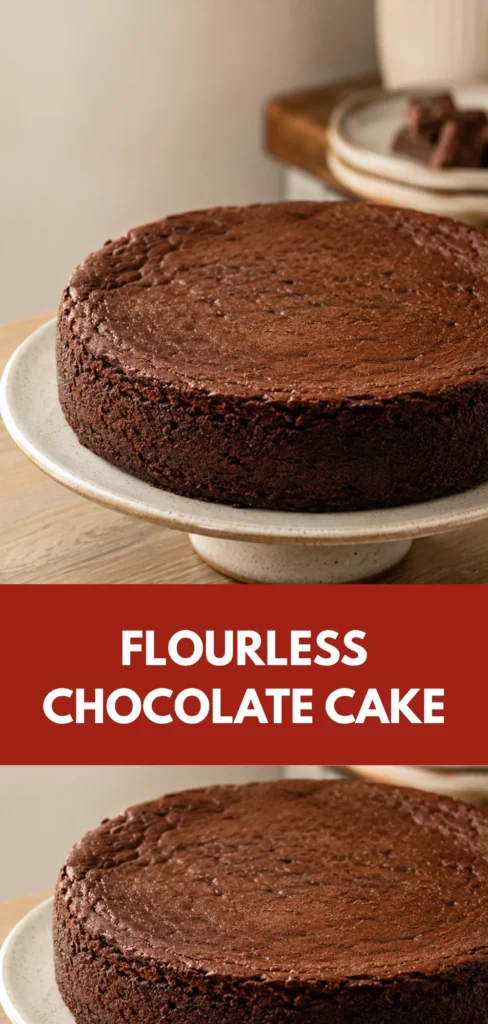
I’ve found that this flourless chocolate cake is much easier to make than the traditional way of preparing this type of dessert. The method skips the extra step of whipping egg whites separately and keeps the preparation simple. Instead, whole eggs are mixed directly into the batter while a small amount of baking powder provides controlled lift during baking.
This approach makes the process easier while preserving the rich, fudgy character expected from a flourless chocolate cake.
Traditional flourless cakes can rise in the oven and then collapse during cooling, sometimes leaving a crater across the top. This can make decorating more difficult and create an uneven surface.
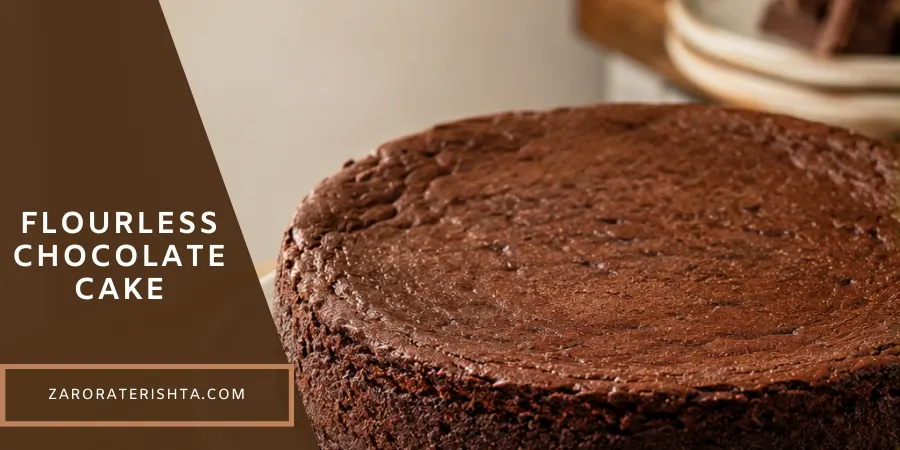
This version uses a simple mix-and-bake approach with a deliberately small amount of baking powder, helping the cake rise gently without relying on whipped egg whites. The result is a more stable cake with a fairly level surface and less risk of dramatic sinking as it cools.
The finished cake has a tender, moist crumb with a thin, fine crackly layer across the top. Its texture falls between a traditional cake and a dense brownie, creating an intensely chocolatey dessert without becoming heavy or dry.
Careful baking is important because the cake contains no flour and relies heavily on eggs, chocolate, butter, and cocoa for its final structure. Overbaking can quickly remove the moist center that makes this dessert special.
I’ve made this style of flourless chocolate cake multiple times, and I prefer it because the preparation is straightforward while the finished cake still feels special enough for serving.
You can finish it with powdered sugar, fresh berries, or whipped cream, but elaborate decoration is not necessary. The deep chocolate flavor, tender texture, and naturally crackled surface already make it feel like a complete dessert.
Ingredients
A flourless chocolate cake uses a short list of ingredients, but each one has an important role in creating its rich flavor, fudgy texture, and stable structure.
For the chocolate base, use:
- 6 ounces (170 grams) high-quality semi-sweet or bittersweet baking chocolate, finely chopped
- ½ cup (113 grams) unsalted butter
Chocolate provides the main flavor, cocoa solids, and part of the cake’s fudgy structure, while unsalted butter adds richness and helps create a smooth, tender texture.
Chocolate in approximately the 55–70% cacao range works well because it provides a balanced combination of chocolate intensity and sweetness. Semi-sweet chocolate creates a slightly sweeter result, while bittersweet chocolate gives a deeper chocolate flavor with less sweetness.
For sweetness and flavor balance, use:
- ⅔ cup (135 grams) granulated sugar
- 2 teaspoons (approximately 4 grams) espresso powder
- 1½ teaspoons (7.5 ml) pure vanilla extract
- ⅛ teaspoon (approximately 0.7 gram) fine salt
The sugar balances the bitterness of the chocolate without making the cake excessively sweet. Espresso powder deepens the chocolate flavor without making coffee the dominant flavor, vanilla rounds out the chocolate, and salt helps balance the sweetness.
For structure and moisture, use:
- 4 large eggs, approximately 200 grams without shells, preferably at room temperature
Because this cake contains no flour, eggs are one of its main structural ingredients. They provide moisture and help emulsify the melted chocolate and butter into a cohesive batter.
Whole eggs are mixed directly into the batter, so there is no need to separate or whip the egg whites.
For additional chocolate intensity and dry solids, use:
- ⅓ cup (27 grams) unsweetened cocoa powder
Sift the cocoa powder before adding it to the batter. This helps break up lumps and allows it to incorporate more evenly into the chocolate mixture.
For controlled lift, use:
- ½ teaspoon (approximately 2 grams) baking powder, optional
This small amount of baking powder provides gentle lift while allowing the cake to remain rich and fudgy rather than becoming light and airy. The quantity is deliberately limited because too much baking powder can make the cake rise excessively and affect the surface as it cools.
How to Make Flourless Chocolate Cake
A Simple Method for a Rich Moist Cake
This flourless chocolate cake starts with a simple preparation, but a few small details make a significant difference. An 8-inch round cake pan gives the cake the intended depth and texture. A 9-inch pan can also be used, but the finished cake will be thinner and will generally require slightly less baking time. A 20cm springform pan is another suitable option.
Preheat the oven to 350°F (177°C). Grease the pan, line the bottom with parchment paper, then grease the parchment and sides of the pan. The parchment is important because the moist chocolate cake can otherwise stick during removal.
Melt the chopped chocolate and butter together in a heat-proof bowl using the microwave in 20-second increments, stirring thoroughly after each interval. Continue until the chocolate is completely smooth.
Let the mixture cool for approximately 2–3 minutes so it remains fluid but is no longer very hot.
Whisk the sugar, espresso powder, vanilla extract, and salt into the melted chocolate mixture. Add the room-temperature eggs and whisk until the batter becomes smooth, glossy, and evenly combined.
The mixture will be thick and rich at this stage because the eggs, chocolate, and butter create the main structure of the flourless batter.
Sift the cocoa powder and optional baking powder over the chocolate mixture. Fold gently with a silicone spatula until no visible dry cocoa remains.
Do not continue mixing once the batter is uniform, as overmixing can affect the final texture.
Pour the batter into the prepared pan and gently level the surface. Place the pan on the center oven rack and bake for approximately 28–32 minutes, with 30 minutes as the starting target.
Begin checking around 28 minutes. The edges should look set while the center should remain slightly soft. A toothpick or cake tester inserted into the center should come out with a few moist crumbs, but it should not carry liquid batter.
The surface may develop a thin crackly layer and a few small cracks. These are normal signs of a properly baked flourless chocolate cake.
Avoid baking until the tester is completely dry. A completely dry tester combined with a firm center usually indicates that the cake has been baked longer than necessary for the intended fudgy texture.
Remove the cake from the oven and place the pan on a cooling rack. Let it cool in the pan for 10 minutes.
Run a thin sharp knife gently around the edges, then carefully remove the cake from the pan. If using a springform pan, release the sides first.
Allow the cake to cool completely before chilling.
Refrigerate the cooled cake for approximately 1–2 hours if you want a firmer texture and cleaner slices. Before serving, let it sit at room temperature for approximately 30–45 minutes.
This allows the chocolate to soften and brings out the best flavor and texture.
Serve in thin slices with powdered sugar, fresh raspberries, strawberries, whipped cream, or another simple topping. The cake does not require elaborate decoration.
For especially clean slices, warm a sharp knife briefly in hot water, wipe it completely dry, and clean the blade between cuts.
Cover leftover cake and refrigerate for up to 5 days.
Tips for the Best Texture
For a rich, fudgy flourless chocolate cake, the most important factor is avoiding overbaking. The center should remain moist and tender rather than becoming firm like a conventional flour cake.
The engineered formula uses 350°F (177°C) and a 28–32 minute baking window, with 30 minutes as the starting target. Because ovens and pans can vary, begin checking at 28 minutes rather than relying only on the clock.
Look for set edges, a slightly soft center, and a few moist crumbs on a toothpick or cake tester. Wet batter means the cake needs more time. A completely dry tester and firm center suggest that the cake may have gone too far.
The formula works because each ingredient has a defined role. The eggs provide much of the structure and moisture, while chocolate and butter supply richness and the characteristic fudgy body. Cocoa intensifies the chocolate flavor and adds dry solids. Sugar contributes sweetness while also influencing moisture and texture. The small amount of baking powder provides controlled lift without turning the cake into an airy sponge.
For that reason, unnecessary substitutions are not recommended. Changes to the chocolate, cocoa, eggs, butter, or dry-to-wet balance can change the final texture significantly. Following the tested formula gives the most reliable result.
Once baked, allow the cake to cool in the pan for 10 minutes, then loosen and remove it carefully. Let it cool completely before refrigerating it for 1–2 hours if cleaner slices are desired.
Before serving, bring it toward room temperature for 30–45 minutes so the chocolate softens and the flavor develops fully.
Make-Ahead, Chocolate, and Baking Notes
The cake batter can be prepared ahead. Complete the batter through the point where it is poured into the prepared pan, cover it well, and refrigerate for up to 1 day before baking.
Because chilled batter is colder and more viscous, it may require a few additional minutes in the oven. Check for doneness rather than relying on the original baking time alone.
For freezing, bake and cool the cake completely as directed. Wrap it tightly in 2 layers of plastic wrap followed by 1 layer of aluminum foil and freeze for up to 3 months.
Thaw overnight in the refrigerator, then allow the cake to come closer to room temperature before decorating or serving.
For the chocolate, use 6 ounces (170 grams) of baking chocolate from the baking aisle. Baking chocolate bars are often sold in 4-ounce portions, so two bars may provide the required amount with some chocolate remaining.
Semi-sweet or bittersweet chocolate in the approximately 55–70% cacao range works well. Bittersweet chocolate creates a darker, less sweet result.
Avoid candy melts, chocolate dipping wafers, and chocolate chips when possible because their added ingredients and stabilizers can change the way the chocolate melts and emulsifies with the butter.
White chocolate and unsweetened chocolate are not recommended for this particular formula because they change the intended balance of sweetness, cocoa solids, and fat.
Espresso powder is optional but useful for deepening the chocolate flavor. It should not make the finished cake taste strongly of coffee.
If necessary, instant espresso or instant coffee granules can be used instead, but ground coffee should not be added because it does not dissolve properly into the batter.
Baking powder is also optional. The ½ teaspoon amount provides modest lift while maintaining the dense, moist character of the cake.
Increasing the amount is not recommended because excessive lift can affect the cake’s surface and stability as it cools.
Room-temperature eggs are preferable because they blend more easily into the melted chocolate and butter mixture. Cold eggs can make the batter noticeably thicker, although the recipe can still work if they are used directly from the refrigerator.
An 8-inch cake pan is the preferred size for the intended thickness. A 9-inch pan can be used when a thinner cake is desired, but the baking time should be checked earlier because the thinner batter will cook more quickly.
For a simple finish, dust the cooled cake lightly with powdered sugar or serve it with well-dried fresh berries. Whipped cream is another suitable accompaniment. These toppings are optional and are not included in the base cake nutrition estimate.
For storage, keep the completely cooled cake covered. At normal room temperature, it is best within approximately 1–2 days.
If the environment is warm, refrigerate it in an airtight container for up to 5 days. Let refrigerated slices sit at room temperature for approximately 30–45 minutes before serving for the best texture.
Nutrition
Based on the base recipe made with 170 grams semi-sweet or bittersweet baking chocolate, 113 grams unsalted butter, 135 grams granulated sugar, 4 large eggs, 27 grams unsweetened cocoa powder, and 12 servings, one serving contains approximately:
- Calories: 220 kcal
- Carbohydrates: 20 g
- Protein: 4 g
- Total Fat: 15 g
- Saturated Fat: 9 g
- Cholesterol: 75 mg
- Sodium: 40 mg
- Potassium: 175 mg
- Fiber: 2 g
- Sugar: 17 g
- Calcium: 30 mg
- Iron: 2 mg
These values are approximate and can vary according to the specific chocolate and cocoa powder used, as well as egg size and brand differences.
The estimate represents one of 12 servings of the base cake only and does not include powdered sugar, berries, whipped cream, ganache, ice cream, or other optional toppings.
Pinterest Pins