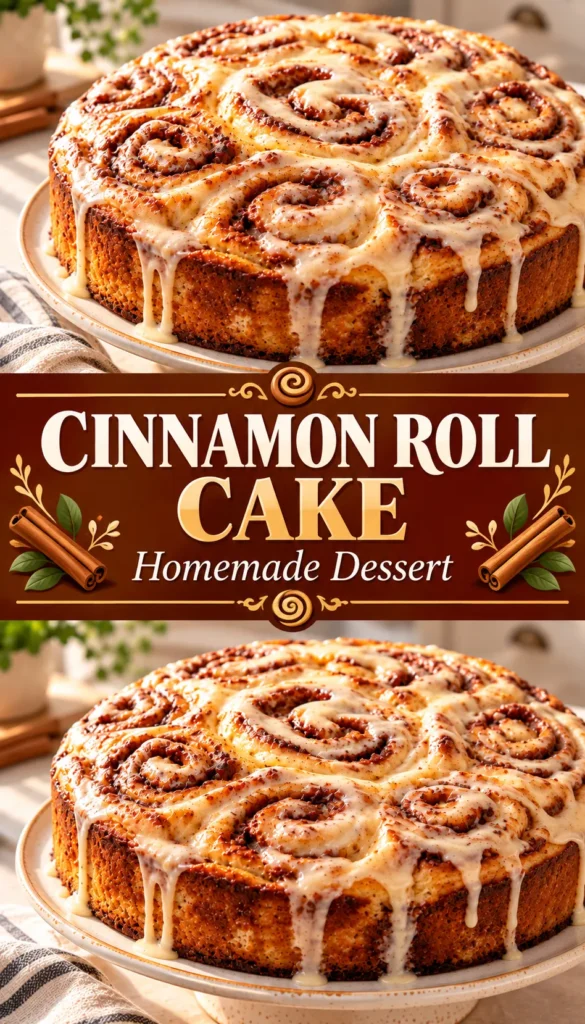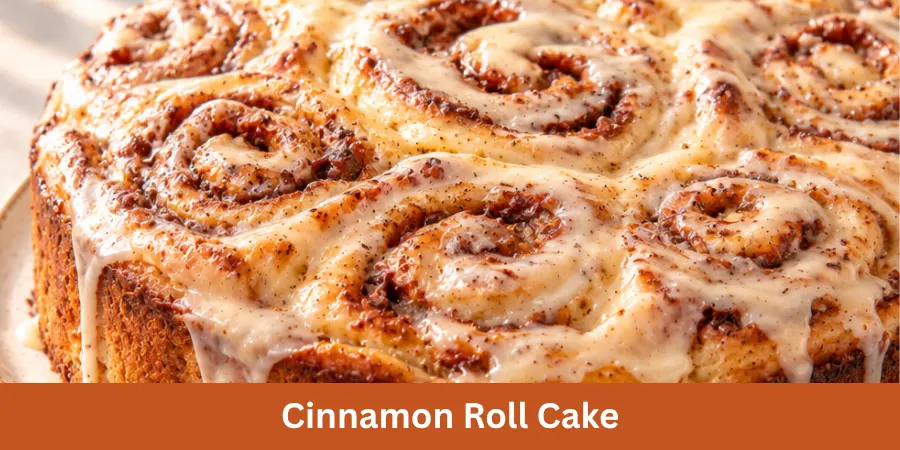
Starting with the idea of a homemade cinnamon roll, this Cinnamon Roll Cake brings the familiar flavor of a classic roll into an easy cake format.
The 7-ingredient cinnamon roll dough is rolled and shaped into one large cake, creating a giant cinnamon roll with soft layers and rich cinnamon flavor.
This method keeps the comforting character of traditional cinnamon rolls while making the process more straightforward.
Cinnamon Roll Cake–The Short Answer
This cinnamon roll cake turns classic cinnamon rolls into one soft, gooey spiral with warm cinnamon filling and vanilla icing. Follow the simple steps for a bakery-style treat at home.
The finished cake should have a soft, pillowy texture with a gooey center and a sweet vanilla icing spread over the top.
The icing adds a fun and indulgent finish without making the cake feel overly heavy. This makes it a simple dessert that works well for both kids and adults.
Because it can be prepared as a large centerpiece, this homemade cake also fits naturally into breakfast or special brunch occasions.
The combination of soft dough, cinnamon filling, and vanilla icing gives it the familiar appeal of a cinnamon roll while presenting it in a different format.
About This Recipe
I have made plenty of homemade cinnamon rolls over the years, and texture is one of the details that makes the biggest difference.
This recipe uses a soft, fluffy, and lightly sweet cinnamon roll dough that bakes into a tender giant roll.
The dough should be fully baked while still keeping a soft center rather than becoming dry.
Making a cinnamon roll cake at home gives you more control over the dough, filling, and icing compared with convenient store-bought options.
The filling combines cinnamon and sugar with buttery richness to create a perfectly spiced layer throughout the roll.
Keeping the filling balanced helps the sweet dough and cinnamon flavor work together without making the cake overly heavy.
The final touch is a simple vanilla icing that adds sweetness without overpowering the cinnamon flavor.
The dough, cinnamon sugar filling, and vanilla icing work together to create a balanced dessert with a soft texture and buttery cinnamon taste.
Served warm, this homemade treat has the comforting qualities that make cinnamon rolls so enjoyable.
Why You’ll Love This Cinnamon Roll Cake
What makes this cinnamon roll cake special is its oversized spiral shape. It has the familiar flavor and soft texture of a classic cinnamon roll, but the large size makes it a fun centerpiece for serving.
The dough is also manageable because it only needs a short rest before shaping and a longer rise before baking.
This makes the process approachable for yeast beginners without requiring specialized tools.
Kids can also help with the shaping stage, making the preparation more enjoyable.
Once baked, the soft cake is covered with vanilla icing that adds sweetness and complements the warm cinnamon filling.
The relaxed rest and rise allow the dough to develop its texture, while the simple shaping method makes this giant cinnamon roll feel more approachable.
The result is a homemade dessert with the familiar flavors of cinnamon rolls in a larger cake-style presentation.
When to Stop Kneading Your Cinnamon Roll Dough
A simple way to check when cinnamon roll dough is ready is the windowpane test. This technique helps determine whether enough gluten development has happened during kneading.
The goal is to create strong gluten bonds that give the dough structure while keeping the final cinnamon roll cake soft and tender. Rather than relying only on kneading time, look for signs that the dough is ready.
The dough should have a smoother surface, feel elastic, and should not be excessively sticky. These texture changes show that the dough has developed enough strength for shaping.
To perform the windowpane test, take a small piece of dough and place it between your fingers. Gently stretch the dough by spreading your fingers apart until it becomes thin and translucent.
Hold it near a window or light source and check whether light can pass through without the dough tearing.
If the dough stretches into a thin membrane, the gluten development is sufficient. If it tears before becoming thin, continue kneading for another 2–3 minutes and repeat the test.
This gives a better indication of dough strength and elasticity than relying on a fixed kneading time alone.
Once the dough passes the test, place it in a lightly greased bowl and cover it. Allow it to rest for 30 minutes before shaping.
The dough may become slightly puffy during this stage, which is normal. Continue with the recipe’s rising and final proofing stages after the dough rest.
Careful dough handling helps maintain the right consistency and texture without unnecessary additional kneading.
Why This Cinnamon Roll Cake Is Great for Yeast Beginners
If cinnamon rolls feel intimidating, this recipe keeps the process manageable for beginners. Homemade dough does not have to be difficult when you understand what each stage is doing.
The dough requires proper kneading, a short rest, and a final proofing period rather than several complicated rises.
Using instant yeast also makes the process straightforward because there is no need to activate it separately first.
With some planning and patience, the result is a soft, fluffy cake with the warm flavor of a gooey homemade cinnamon roll.
My tip for successful cinnamon roll baking is to avoid rushing the process. After kneading, the dough rests briefly so the gluten can relax before shaping.
It then goes through a 1–2 hour final proof, but the exact rise time depends on the dough and room temperature.
Look for a noticeably puffy dough with expanded coils and a gentle poke that slowly springs back instead of relying only on the clock.
These signs help prevent dense rolls and create a softer finished cake.
This method makes working with yeast more approachable because the recipe provides clear signs for checking the dough.
The windowpane test helps confirm that enough gluten has developed before shaping, while the final proof shows when the dough is ready to bake.
Ingredients Needed
Yield: 1 giant 9-inch cinnamon roll cake (12 servings)
Dough
- 2½ cups (313 g) all-purpose flour
- ¼ cup + 1 tablespoon (65 g) granulated sugar
- 2¼ teaspoons (7 g) instant yeast
- ¾ teaspoon (4 g) fine salt
- ¾ cup (180 ml) whole milk
- 5 tablespoons (70 g) unsalted butter
- 1 large egg (50 g without shell)
Cinnamon Filling
- 5 tablespoons (70 g) softened unsalted butter
- ⅓ cup (67 g) packed light brown sugar
- 1½ tablespoons (10 g) ground cinnamon
- ⅛ teaspoon (0.5 g) fine salt
Vanilla Icing
- 1 cup (120 g) powdered sugar
- 2 tablespoons (30 ml) whole milk
- 1 teaspoon (5 ml) pure vanilla extract
Extras
- 1–2 tablespoons (10–15 g) all-purpose flour, for dusting the work surface
- About 1 teaspoon oil or nonstick baking spray, for greasing the bowl
Ingredients Notes
The dough creates the soft and fluffy base of this cinnamon roll cake.
Use 2½ cups (313 g) all-purpose flour as the main structure for the dough. The flour provides the foundation needed for rolling and shaping the large spiral cake.
Granulated sugar adds sweetness to the dough while also contributing to the overall flavor. Use ¼ cup + 1 tablespoon (65 g) granulated sugar.
Fine salt balances the sweetness and helps enhance the flavors of the dough and filling.
Instant yeast helps the dough rise and creates the soft texture expected from a cinnamon roll.
Use 2¼ teaspoons (7 g) instant yeast. Since this recipe uses instant yeast, it can be mixed directly with the dry ingredients before adding the wet ingredients.
Whole milk and butter add moisture, richness, and tenderness to the dough.
Use ¾ cup (180 ml) whole milk and 5 tablespoons (70 g) unsalted butter. The milk should be gently warmed with the butter before being added to the dough mixture.
The egg adds richness and helps create a tender dough texture.
Use 1 large egg (50 g without the shell). It contributes moisture and structure while helping the dough develop a soft texture.
The cinnamon filling creates the classic flavor of a cinnamon roll.
Use 5 tablespoons (70 g) softened unsalted butter, ⅓ cup (67 g) packed light brown sugar, 1½ tablespoons (10 g) ground cinnamon, and ⅛ teaspoon (0.5 g) fine salt.
Softened butter spreads easily across the dough while the brown sugar and cinnamon create the sweet, spiced center.
Keeping the filling evenly spread helps create balanced cinnamon flavor throughout the large spiral cake.
The vanilla icing adds sweetness and a smooth finishing layer.
Use 1 cup (120 g) powdered sugar, 2 tablespoons (30 ml) whole milk, and 1 teaspoon (5 ml) pure vanilla extract.
The finished icing should be thick and spreadable so it creates an even layer over the cinnamon roll cake.
These simple ingredients work together to create the three main components of the recipe:
The soft dough provides structure, the cinnamon filling adds the classic spiced flavor, and the vanilla icing completes the dessert-style finish.
How to Make Cinnamon Roll Cake
Start by preparing the cinnamon roll cake dough.
Prepare a 9×2-inch round cake pan (at least 2 inches deep) by spraying it with nonstick baking spray and lining it with parchment paper.
In a large bowl or stand mixer, combine the all-purpose flour, granulated sugar, instant yeast, and fine salt.
Separately, gently warm the whole milk and unsalted butter together until the butter is mostly melted and the mixture reaches 100–110°F (38–43°C).
Add the warm milk mixture and the egg to the dry ingredients. Mix until a soft dough forms.
The dough should feel soft and slightly sticky, so avoid adding extra flour too quickly.
Knead the dough with a dough hook on low to medium-low speed for 8–10 minutes, or by hand for 10–12 minutes, until it feels smooth and elastic. Check it with the windowpane test described above.
Place the dough in a lightly greased bowl, cover it, and let it rest for 30 minutes. It may become slightly puffy, which is normal.
While the dough rests, prepare the cinnamon filling by combining the softened butter, packed light brown sugar, ground cinnamon, and fine salt in a medium bowl.
Mix until the filling forms a smooth paste. Transfer the dough to a lightly floured surface and roll it into a 15×12-inch rectangle about ¼ inch thick, taking care not to roll it too thin.
Spread the cinnamon filling evenly across the surface while leaving a ½-inch border around the edges. This helps prevent the filling from leaking out during shaping.
Cut the dough into 6 equal strips along the 15-inch side, each about 15 inches long and 2 inches wide.
Roll one strip from a short end, with the filling side facing inward, into a snug center coil and place it in the middle of the prepared pan with the cut edge facing up.
Press the end of each remaining strip against the end of the previous strip and wrap it around the center in the same spiral direction, with the filling side facing inward and the cut edge facing up, to create the large spiral shape.
Keep the coils snug but avoid stretching, squeezing, or compressing the dough.
If some filling spills out while shaping, gently press or spread it back over the top. This helps keep the cinnamon flavor evenly distributed throughout the cake.
Cover the shaped cake loosely and let it rise in a warm, draft-free place for 1–2 hours. This timing is for a kitchen at about 72–78°F (22–26°C); the dough will be ready sooner in a warmer kitchen.
Instead of relying only on the clock, check that the dough looks noticeably puffy, the coils have expanded, the gaps have mostly closed, and the dough has risen close to the rim of the pan.
A gentle poke should slowly spring back when the dough is ready.
About 15–20 minutes before the dough is ready, preheat the oven to 350°F (177°C).
Bake the cinnamon roll cake at 350°F (177°C) for 30–35 minutes.
The top should be golden brown and the center should be set with an internal temperature of 190–195°F (88–91°C). If the top starts browning too quickly, loosely cover it with aluminum foil.
Check the temperature at the 30-minute mark. If the center has not reached 190°F (88°C), keep baking in 5-minute intervals, up to about 40 minutes total.
Some uneven rising is normal with a large spiral cake.
If some areas become taller after baking, use oven mitts and gently press them down with the back of a spatula if needed.
Let the cake cool in the pan on a wire rack for 10 minutes before adding the icing.
For the vanilla icing, whisk together the powdered sugar, whole milk, and pure vanilla extract until smooth and thick.
Add a little more milk if the icing is too thick or more powdered sugar if it needs to become thicker. For a thinner, drizzle-style icing, whisk in 10–15 ml (2–3 teaspoons) extra milk.
Spread the icing over the slightly warm cake. Allow it to set for about 10 minutes, then slice with a serrated or sharp knife.
A short cooling period helps the cake structure stabilize, making it easier to cut while keeping the center soft and tender.
Storage
If you want fresh cinnamon rolls in the morning without preparing everything at the start of the day, prepare the cinnamon roll cake through the shaping step.
Cover it tightly and refrigerate it for 8–12 hours. This overnight rest allows the shaped dough to stay ready for baking the next day.
The next morning, remove the cake from the refrigerator and let it rise while covered for 1–2 hours.
Check the appearance instead of relying only on the clock. Once the dough looks puffy and passes the poke test, continue with baking.
You can also freeze the shaped cake before its rise for up to 3 months.
When ready to use it, thaw the cake in the refrigerator overnight, then allow it to rise while covered until it reaches the final proof stage before baking.
For a fully baked cinnamon roll cake, let it cool completely, cover it tightly, and freeze it. Thaw it in the refrigerator overnight or at room temperature, then follow the reheating instructions.
Tips for Better Cinnamon Roll Cake
For this cinnamon roll cake recipe, a 9×2-inch round cake pan works well for creating the large spiral shape.
During baking, some areas may rise higher than others. This is completely normal with a giant cinnamon roll cake because of its large spiral structure.
If some sections are taller once the cake is out of the oven, use oven mitts and gently press down the higher areas with the back of a spatula.
This helps create a more even surface while keeping the soft texture of the cake.
For homemade cinnamon rolls, simple ingredients can make a noticeable difference in the finished result.
Choose high-quality ingredients, especially good butter and quality cinnamon. The goal is a soft, gooey center, but there is a fine line between that texture and a center that is too doughy.
Check the cake at the 30-minute mark to avoid overbaking. The cake will continue baking slightly as it begins to cool, so avoid leaving it in the oven longer than needed.
To save time in the morning, prepare the dough and complete the shaping process the night before.
Refrigerate the shaped cake until the next day. This allows you to complete the final rise and baking when you are ready to serve it.
Cinnamon rolls are especially enjoyable warm from the oven, but leftovers can still be enjoyed later.
Reheat an individual slice in the microwave for 10–15 seconds. Add additional 5-second intervals if needed to restore the warm, soft texture.
To reheat in the oven, warm slices at 300°F (149°C) for about 5–8 minutes, avoiding overheating.
Notes
For the filling, 5 tablespoons of butter is enough when combined with brown sugar and cinnamon.
Spread the mixture evenly over the dough while leaving a small border around the edges.
This helps keep the filling in place when cutting the dough and arranging the strips in the pan.
If you want to prepare the rolls the day before, complete the shaping process and place the cake in the pan.
Cover it tightly and refrigerate overnight for 8–12 hours. The next morning, let it rise for 1–2 hours in a warm area.
Check that the dough looks puffy and the coils have expanded before baking. The cake can be served warm or at room temperature.
For the best texture, let it cool briefly after baking before adding the icing and slicing. This allows the cake to settle while keeping its soft texture.
Nutrition Insight
One serving (1/12 of the cake, including the full vanilla icing) of this cinnamon roll cake provides approximately:
- 280 kcal
- 42.4 g carbohydrates
- 3.9 g protein
- 10.7 g total fat
- 164 mg sodium
- 1.1 g fiber
- 21.9 g total sugars
These nutrition values are estimates based on one serving of the recipe.
The final values may vary slightly depending on the specific brands of ingredients used.
Since this is a rich baked dessert, keeping the serving size in mind can help when enjoying it as part of a meal or snack.
Frequently Asked Questions
Can This Cinnamon Roll Cake Recipe Be Cut in Half?
Halving this recipe has not been tested, so I cannot recommend a pan size, a baking time, or how to divide the egg. For the tested result, make the full recipe in a 9×2-inch round pan; leftovers can be stored or frozen as described above.
Can You Make It as a Bundt Cake or Cupcakes?
This recipe is designed to work best in a 9×2-inch round cake pan because it supports the spiral structure.
Other formats, such as a bundt pan or cupcakes, have not been tested and are not recommended, since the coil structure may not bake the same way.
For leftover cinnamon roll cake, allow it to cool completely and keep it covered in an airtight container.
With standard vanilla icing, it is best stored on the counter and served the same day or the next day. The cake can also be frozen for up to 3 months.
Pinterest Pins